Microwave Repair Decision Tool
Step 1: Describe Your Problem
Step 2: Microwave Age & Condition
Step 3: Safety Check
Your Repair Recommendation
If your microwave stopped heating, makes strange noises, or the door won’t close properly, you don’t need to replace it right away. Many common microwave problems can be fixed at home with basic tools and a little know-how. In New Zealand, where appliance repair services can be slow and expensive, knowing how to troubleshoot your microwave saves time and money. Most issues aren’t dangerous if handled carefully-and they’re often just a loose part, a dirty component, or a blown fuse.
Is it even worth fixing?
Before you grab a screwdriver, ask yourself: how old is the microwave? If it’s over 8 years old, replacement might be smarter. Modern microwaves cost between $150 and $300 here in Auckland, and newer models are more energy-efficient. But if your microwave is under 5 years old and was expensive to buy, fixing it makes sense. Also, check if it’s still under warranty. Some brands like Panasonic and LG offer 1-2 year warranties on parts.
Don’t try to fix a microwave if:
- The outer casing is cracked or melted
- You see smoke or burning smells
- The turntable motor is seized and sparks are coming from inside
These are signs of serious electrical damage. Call a professional. But for most other issues-like no heat, weird noises, or a door that won’t latch-you can safely try the fixes below.
Problem 1: Microwave doesn’t heat food
This is the #1 complaint. The microwave runs, the light turns on, the turntable spins-but your leftovers stay cold. The most likely culprit? The high-voltage diode is a small component that converts AC power into DC power for the magnetron, which generates microwaves. It’s often the first thing to fail.
Here’s how to check it:
- Unplug the microwave. Always. Even if you think it’s off.
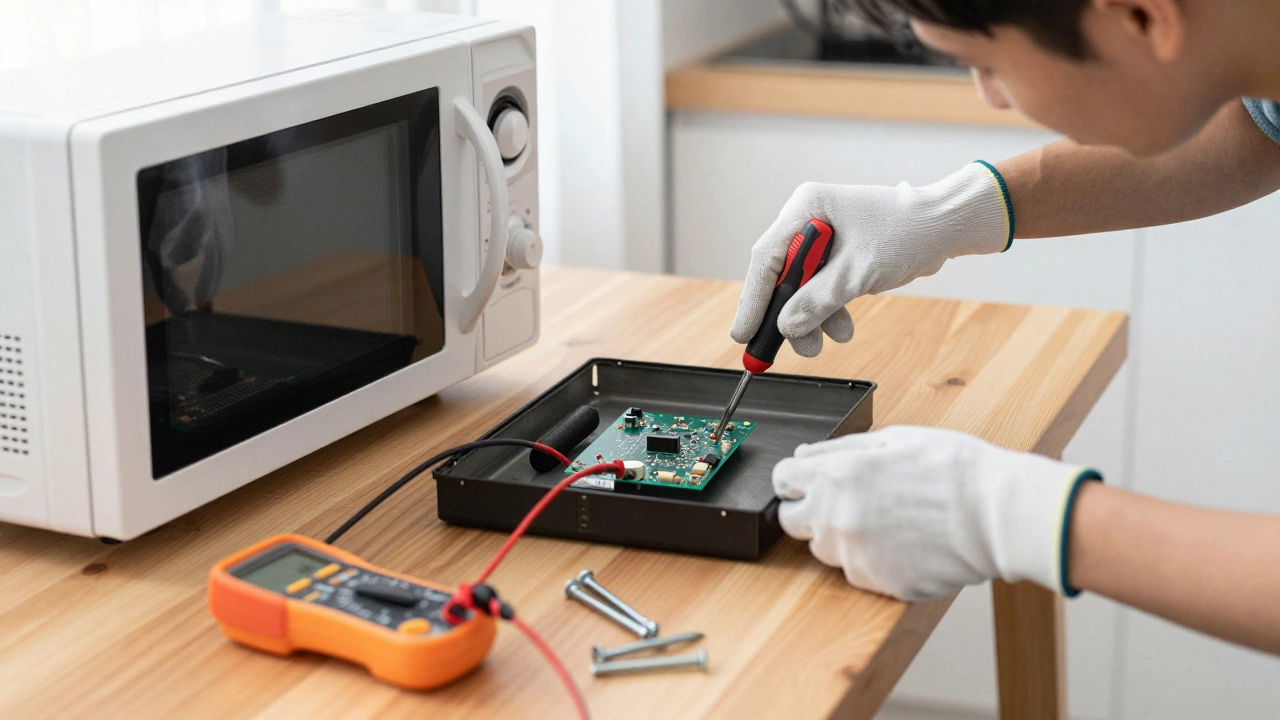
- Remove the outer casing. Most models have 5-8 screws on the back or sides. Keep them in a small container so you don’t lose them.
- Locate the magnetron (a metal box with wires going into it) and trace the wires to a small black cylinder with two terminals-that’s the diode.
- Use a multimeter set to diode mode. Touch the probes to each terminal. If it reads "OL" (open loop) in both directions, the diode is dead.
- Replace it. Diodes cost under $15 online. Match the model number from your microwave’s label.
Another possible cause: the magnetron is the component that produces microwave radiation to heat food. It’s harder to test without professional tools, but if the diode is fine and there’s still no heat, the magnetron may have failed. Replacing it costs $60-$100. If you’re not confident, skip this step.
Problem 2: Sparking or arcing inside
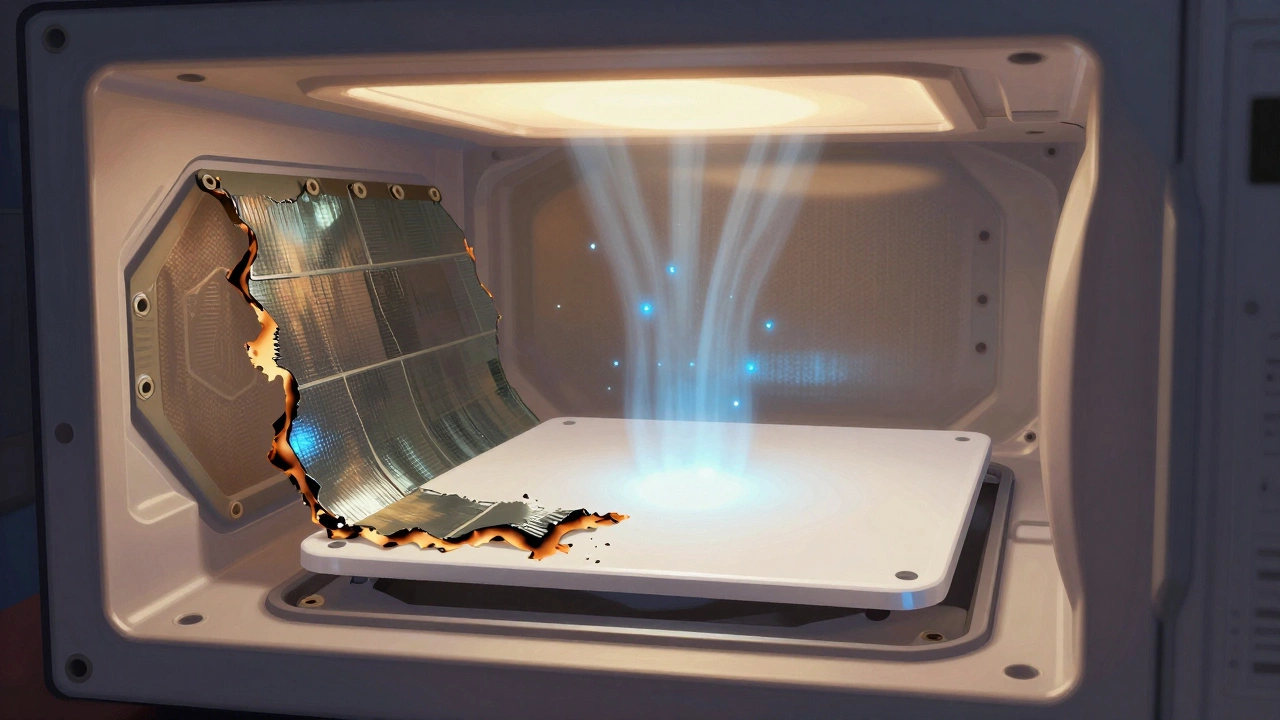
If you see blue flashes or hear popping sounds when the microwave runs, something’s wrong. This isn’t normal. Sparks usually mean metal is touching the cavity wall-but sometimes, it’s the waveguide cover is a mica or plastic panel that protects the opening where microwaves enter the cooking chamber.
Here’s what to do:
- Look inside the microwave. On the side wall or ceiling, you’ll see a rectangular panel-usually white or beige. That’s the waveguide cover.
- If it’s stained with grease, charred, or has holes, it needs replacing.
- Unplug the microwave. Remove the cover by gently prying it off. It’s held by small clips or adhesive.
- Buy a replacement from a parts supplier like Appliance Parts NZ or eBay. Make sure the size matches.
- Install the new one. It doesn’t need screws. Just press it into place.
Also, check for metal objects you might have left inside-a spoon, foil, or even a decorative plate with metallic paint. Even a tiny bit of foil can cause sparks. Clean the cavity with warm water and dish soap. Never use abrasive cleaners.
Problem 3: Door won’t close or latch
A microwave won’t run if the door doesn’t seal properly. Safety switches cut power if the door is open. If the door feels loose, sticks, or doesn’t click shut, the issue is usually the door latch is a mechanical switch that confirms the door is closed before the microwave activates or the door switch is a small electrical switch that signals the control board when the door is sealed.
Try this:
- Open the door and look at the latch mechanism. It’s usually near the hinge side. Is it broken? Cracked? Missing a piece?
- Try closing the door gently. Does it feel like it’s catching? If it’s sticky, clean the latch area with rubbing alcohol on a cotton swab.
- If the latch looks intact but the microwave still won’t turn on, the door switch might be faulty. You’ll need to remove the outer panel to access it. There are usually two or three switches. Test each with a multimeter. If any show no continuity when pressed, replace it.
- Replacement switches cost $8-$15. Match the part number exactly.
Don’t force the door. If it’s bent, the whole door assembly might need replacing. That’s more complex-consider professional help.
Problem 4: Microwave makes loud noises
Humming? Grinding? Buzzing? A little noise is normal. But if it’s suddenly louder or sounds like a motor straining, something’s wrong.
- Grinding noise: Usually the turntable motor is a small electric motor that rotates the glass plate to ensure even cooking. Remove the glass tray and roller ring. Check if the motor shaft is stuck. If it spins freely by hand, the motor is likely fine. If it’s stiff or makes grinding sounds when you turn it, replace the motor. Costs $25-$40.
- Loud humming: Could be the cooling fan is a small fan that keeps the magnetron and electronics from overheating. Dust buildup is the usual cause. Unplug the unit, remove the back panel, and vacuum the fan blades. If the fan is noisy even after cleaning, it may need replacing.
- Buzzing without heating: This often points to a failing capacitor. The high-voltage capacitor is a component that stores electrical energy to power the magnetron. It’s dangerous to handle-can hold a charge even when unplugged. If you’re not experienced with electronics, skip this one.
Quick safety checklist before you start
- Always unplug the microwave. Never work on it while plugged in.
- Wait 20 minutes after unplugging. Capacitors can hold a charge.
- Wear rubber-soled shoes and dry gloves.
- Use insulated tools. Metal screwdrivers can short circuits.
- Never bypass safety switches. They exist to prevent radiation leaks.
- If you’re unsure, stop. Call a technician. A $100 repair is cheaper than a hospital bill.
When to call a professional
You’ve tried everything. The microwave still doesn’t work. Or you’re uncomfortable opening it up. That’s okay. In Auckland, reputable appliance repair shops like Appliance Fix NZ or ElectroCare charge $80-$120 for diagnostics and $150-$250 for parts and labor. They can replace magnetrons, control boards, and high-voltage components safely.
Also call if:
- The microwave displays error codes (like E1, E2, etc.)
- The keypad is unresponsive or buttons are stuck
- You smell burning plastic or ozone
- The microwave runs but doesn’t heat, and you’ve already replaced the diode and magnetron
Prevent future problems
Simple habits extend your microwave’s life:
- Clean the inside weekly with vinegar and water. Buildup attracts arcing.
- Never run it empty. Even 10 seconds without food can damage the magnetron.
- Use microwave-safe containers. Avoid metal, foil, or takeout containers with metallic trim.
- Don’t slam the door. It wears out the latch and switches faster.
- Keep vents clear. Dust on the back or sides blocks airflow and overheats components.
Can I fix a microwave that sparks when I use it?
Yes-if the sparking is caused by a damaged waveguide cover or leftover metal. Unplug the microwave, inspect the inside for charred plastic or foil, and replace the waveguide cover if it’s damaged. If sparks continue after cleaning and replacing the cover, stop using it. There could be internal damage to the magnetron or cavity walls, which require professional repair.
Why does my microwave run but not heat food?
The most common reason is a failed high-voltage diode, which powers the magnetron. Less commonly, the magnetron itself is dead, or the thermal fuse has blown. Start by testing the diode with a multimeter. If it’s open circuit, replace it. If the diode tests fine, the magnetron likely needs replacing-but that’s more expensive than replacing the microwave in many cases.
Is it safe to open a microwave to fix it?
It’s safe if you follow basic precautions: unplug it, wait 20 minutes for capacitors to discharge, and avoid touching high-voltage components like the capacitor or magnetron. Use insulated tools and wear dry gloves. Never attempt repairs if you’re not comfortable with electronics. Microwaves can store lethal voltage even when unplugged. If in doubt, call a technician.
How long does a microwave usually last?
Most microwaves last 7 to 10 years with normal use. Heavy use, poor ventilation, or frequent overheating can shorten that. Signs of aging include longer heating times, unusual noises, or frequent tripping of the thermal fuse. If your microwave is over 8 years old and needs major repairs, replacing it is often more cost-effective than fixing it.
Can a faulty door switch cause the microwave to not turn on?
Yes. The door switch is part of a safety circuit that prevents the microwave from operating unless the door is fully closed. If one of the switches fails, the microwave won’t power on-even if the light and turntable work. You can test them with a multimeter. If any switch doesn’t show continuity when pressed, replace it. They’re inexpensive and easy to swap.
Final tip: Keep a repair log
Write down what you fixed, what part you replaced, and when. That way, if the same problem comes back in 6 months, you’ll know what to check first. Many microwaves fail in the same way twice-especially if the root cause wasn’t fully addressed. A simple notebook with dates and part numbers can save you hours of guesswork later.