Water Heater Value Calculator
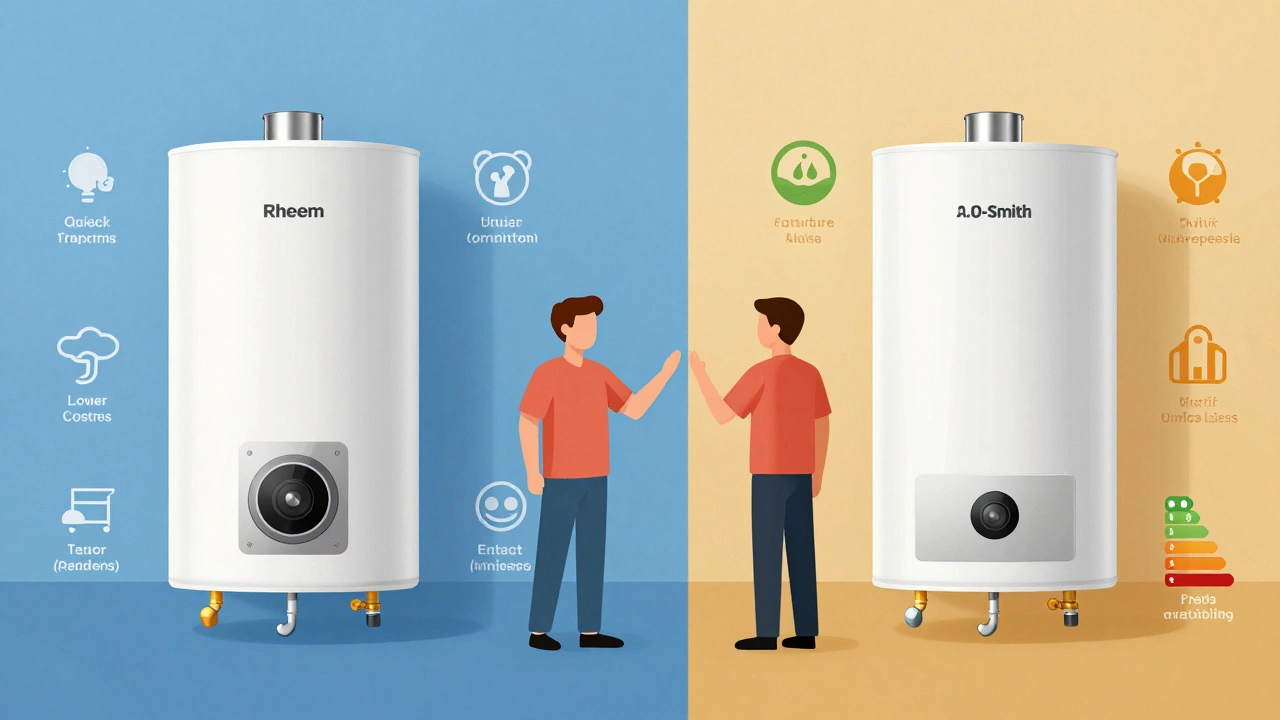
Standing in the aisle at a hardware store or scrolling through online listings, you see two names pop up constantly: Rheem is a major American manufacturer of heating and cooling equipment known for affordability and widespread availability. Right next to it sits A. O. Smith, which is a heritage brand founded in 1916 that emphasizes durability, premium materials, and longer lifespans. If you are dealing with a leaking unit, strange noises, or just planning an upgrade, the question isn't just about price tags. It is about who will show up when things break, how long the unit lasts, and whether your wallet can handle the maintenance over ten years.
I have spent years looking under sinks and behind panels in Auckland homes. The truth is, neither brand is universally "better." They serve different needs. One prioritizes accessibility and cost-effectiveness; the other bets on build quality and longevity. Let's break down exactly what that means for your repair bills, energy usage, and peace of mind.
The Core Philosophy: Value vs. Durability
To understand why these brands feel different, you have to look at their design goals. Rheem operates on a high-volume model. They produce millions of units annually, keeping costs down by using standardized parts and efficient manufacturing processes. This makes them incredibly accessible. If you need a replacement fast and on a budget, Rheem is often the go-to. Their parts are everywhere, and almost every technician knows how to fix them because they are so common.
A. O. Smith takes a different approach. They focus on engineering resilience. You will notice thicker steel tanks, better glass linings, and more robust burners in their mid-to-high-end models. The idea is simple: if the unit lasts longer, the total cost of ownership drops, even if the upfront price is higher. For homeowners who plan to stay in their house for a decade or more, this durability can outweigh the initial savings of a cheaper brand.
| Feature | Rheem | A. O. Smith |
|---|---|---|
| Primary Focus | Affordability & Availability | Durability & Performance |
| Average Lifespan (Tank) | 8-10 years | 10-15 years |
| Parts Availability | Extremely High | High (but slightly less than Rheem) |
| Repair Complexity | Low (Standardized) | Medium (Varies by tier) |
| Best For | Budget-conscious buyers, rentals | Long-term homeowners, high-demand households |
Tankless Water Heaters: The Real Battle
Where the debate gets interesting is in the tankless category. Both brands dominate this space, but their strategies diverge significantly. Rheem’s tankless units, like the Rheem Performance Platinum, are designed for ease of installation and straightforward diagnostics. They use electronic ignition systems that are reliable but can be sensitive to hard water mineral buildup-a common issue in many regions.
A. O. Smith’s tankless line, particularly the Vertex series, often features dual heat exchangers and more advanced modulation controls. This allows them to maintain precise temperature stability even when multiple fixtures are running. However, this complexity comes at a cost. When an A. O. Smith tankless unit fails, the diagnosis might require specialized tools or firmware updates that not every general handyman can perform. Rheem’s simpler architecture means more technicians can jump in and fix it quickly.
If you live in an area with very hard water, both brands require regular descaling. But A. O. Smith units often have better internal flow sensors that warn you before damage occurs. Rheem units might just shut down, leaving you guessing what went wrong until you call a pro.
Repair Costs and Technician Availability
This is where the rubber meets the road. You don’t buy a water heater for one day; you buy it for ten. What happens when it breaks?
Rheem wins on sheer numbers. Because they sell more units globally, there is a larger pool of independent technicians who are certified to work on them. In Auckland, for example, most local repair shops stock Rheem thermostats, gas valves, and heating elements as standard inventory. This means faster repairs and lower labor rates because the job is routine.
A. O. Smith requires a bit more expertise. While still widely serviced, some of their premium components-like specific control boards or proprietary venting kits-are not as commonly kept in stock by smaller shops. You might pay a premium for a technician who specializes in A. O. Smith systems. However, because these units tend to fail less frequently, you may only face this scenario once or twice in the unit’s life, whereas a Rheem owner might deal with minor issues more often due to thinner materials and shorter warranties on certain parts.
Warranty and Long-Term Support
Warranties tell you what the manufacturer expects from their product. Rheem typically offers 6-year warranties on standard gas tanks and 10-year on premium models. A. O. Smith often matches or exceeds this, with some lines offering up to 12-year warranties on the tank itself. More importantly, A. O. Smith has a reputation for honoring warranties smoothly, even decades after purchase, thanks to their strong dealer network.
Rheem’s warranty process can sometimes be bureaucratic. They rely heavily on authorized service providers, which can limit your choice of technician. If your local plumber isn’t on the list, you might struggle to get a free part covered. A. O. Smith tends to be more flexible, allowing any licensed professional to claim warranty parts, which gives you more freedom in choosing who fixes your home.
Energy Efficiency and Operating Costs
Efficiency matters for your monthly bills. Both brands offer Energy Star-rated models, but A. O. Smith often edges out Rheem in peak efficiency ratings for comparable sizes. Their combustion chambers are designed to extract more heat from the gas, meaning less waste. Over five years, this can translate to noticeable savings, especially in colder climates where hot water demand is higher.
Rheem compensates with smart connectivity options. Many of their newer models integrate easily with home automation systems, allowing you to monitor usage and adjust settings remotely. This doesn’t directly save energy, but it helps you identify leaks or unusual consumption patterns early, preventing bigger problems later.
Which One Should You Choose?
Your decision should hinge on three factors: budget, lifespan expectation, and local support.
- Choose Rheem if: You are on a tight budget, renting out a property, or need a quick, no-fuss replacement. You want easy access to parts and technicians without waiting weeks for specialized help.
- Choose A. O. Smith if: You plan to stay in your home long-term, want maximum durability, and prefer fewer interruptions from repairs. You are willing to pay more upfront for potentially lower lifetime costs.
In Auckland’s humid climate, corrosion resistance is key. A. O. Smith’s superior glass lining technology generally holds up better against acidic water conditions. If you have hard water, invest in a filtration system regardless of the brand, but lean toward A. O. Smith for its robust internal components.
Is Rheem or A. O. Smith easier to repair?
Rheem is generally easier to repair due to its standardized parts and widespread technician familiarity. Most plumbers carry Rheem components in stock, leading to faster turnaround times. A. O. Smith units may require specialized knowledge for complex models, potentially increasing repair time and cost.
Do A. O. Smith water heaters last longer than Rheem?
Yes, on average. A. O. Smith uses thicker steel and higher-quality glass linings, which resist corrosion better. While a Rheem tank might last 8-10 years, an A. O. Smith unit often reaches 10-15 years with proper maintenance, making it a better long-term investment for permanent residents.
Are Rheem parts cheaper than A. O. Smith parts?
Usually, yes. Rheem’s mass production keeps component costs low. Thermostats, heating elements, and gas valves for Rheem units are often 10-20% cheaper than equivalent A. O. Smith parts. However, since A. O. Smith parts fail less frequently, the total spending over the unit's life may be similar.
Which brand is better for tankless water heaters?
It depends on your priority. Rheem offers simpler, more affordable tankless units that are easy to install and repair. A. O. Smith provides higher-performance models with better temperature consistency and durability, ideal for large households with high hot water demands. For complex installations, A. O. Smith’s engineering edge shines.
Can I switch from Rheem to A. O. Smith during a repair?
You cannot simply swap parts between brands. Rheem and A. O. Smith use different designs, fittings, and control systems. Switching brands requires replacing the entire unit, including venting and gas connections. Ensure your new A. O. Smith model fits your existing space and meets local code requirements before purchasing.